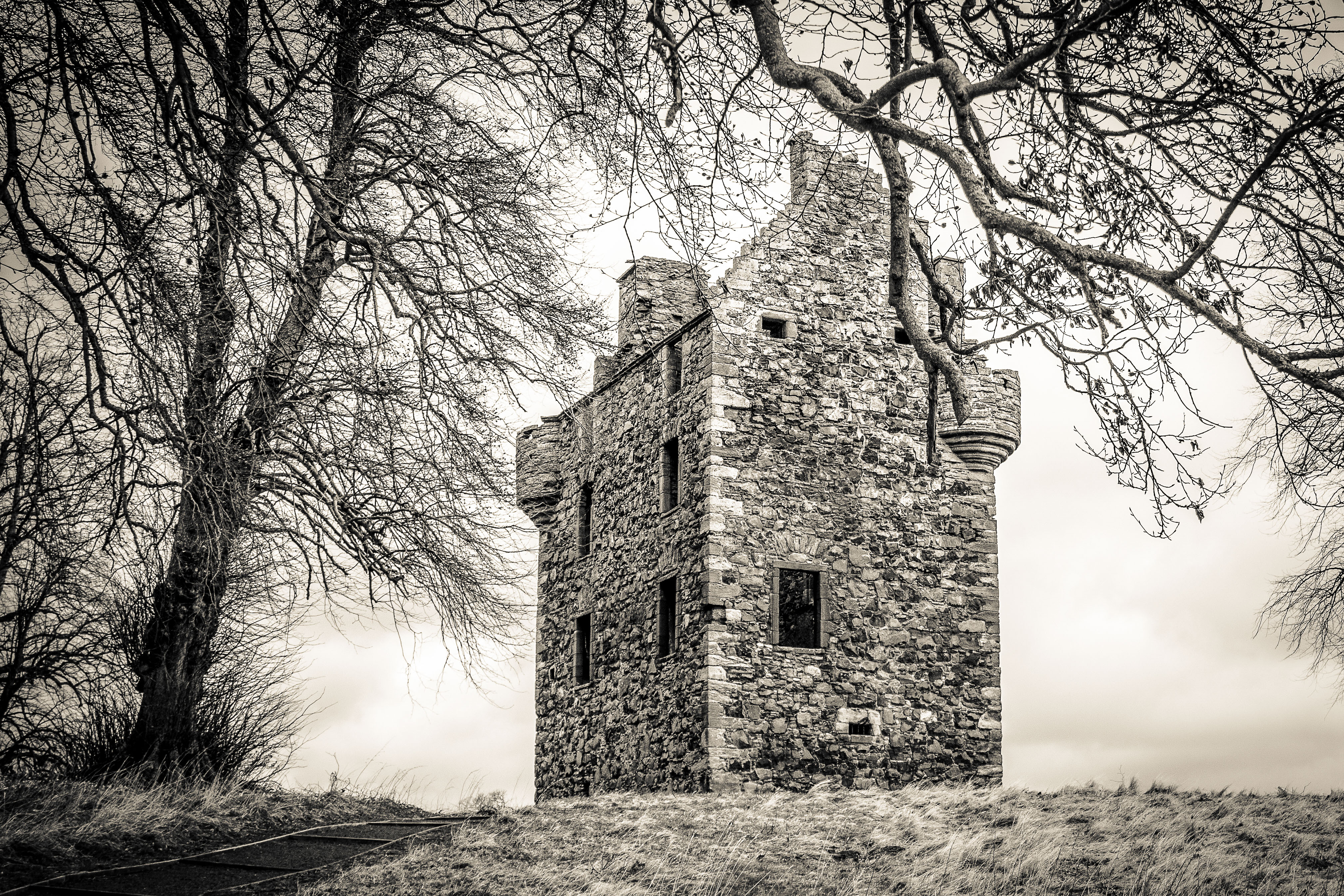
Greenknowe Tower — photograph by Tara Grey, 9 March 2014
Greenknowe Tower stands on the outskirts of Gordon village. It is the impressive and remarkably well-preserved shell of an L-plan tower house, built by the Setons of Touch in 1581, probably on the site of an earlier building. The arms and initials of James Seton and his second wife, Jane Edmonstone, along with the date of construction, are carved in the lintel above the entrance, a personal mark that has endured for more than four centuries.
It was a comfortable house, built both as a family stop-over home and for the defence of the farmlands, in compliance with the King's order of the time that all lands of a certain size and value were to be protected by a tower and by fortifications. The main block contained a vaulted ground floor and four upper floors, and was situated on a low grassy mound known as a knowe, surrounded by marshy ground not much changed today, though the fine gardens which once existed are long gone. The characteristic L-plan shape, with its corbelled corner turret, is typical of Scottish tower houses of the period: practical, imposing, and built to last.
The Gordons and the Setons
The story of Greenknowe is bound up with the story of Gordon itself. The Gordons, one of the most powerful clans in the north east of Scotland in the late Middle Ages, traced their origins back to this corner of Berwickshire. Richard de Gordon is on record as having granted lands to Kelso Abbey in 1160, making him the first of the surname recorded in Scotland, and the parish of Gordon remained the principal seat of the family for generations. It was from here that the Gordons rose to prominence, before Sir Adam de Gordon carried the Declaration of Arbroath to the Pope in 1320 and was rewarded by Robert I with the estate of Strathbogie in Aberdeenshire. The clan moved north in the early 14th century, and Greenknowe Tower stands in the heart of their old parish. It may well stand on the site of the Gordons' first Scottish castle.
The Setons came to Greenknowe through marriage. When Sir Alexander de Seton wed Elizabeth Gordon in 1408, the Gordon estates, including Greenknowe, passed to the Seton family, with Sir Alexander later becoming the first Lord Gordon. It was a later member of the family, James Seton of Touch, who built or substantially remodelled the tower we see today, leaving his mark quite literally above the door.
The Covenanters and Later Owners
In the early 1600s, Greenknowe passed to the Pringles of Stichel, a local Borders family. It was during this period that the tower became the home of Walter Pringle of Greenknowe, one of the most prominent Covenanters of his age. The Covenanters were Scottish Presbyterians who resisted royal interference in the governance of the church, and Pringle was among their most committed voices. He may have refurbished and extended the tower during his time here, and in his Memoirs of a Covenanter, written at Greenknowe and published posthumously in 1723, he describes gardens, fruit trees and a broad avenue of trees, conjuring a picture of a well-ordered and cultivated home.
Later still, the tower passed through the hands of the Fairholms and then the Dalrymples. It was finally abandoned as a residence in 1830, and in 1937 was placed in state care, with repairs part-financed by the Dalrymple Archaeological Fund. Archaeological excavations in 1978 located a stable and part of the barmkin wall, the defensive enclosure that would once have surrounded the tower. Today it is in the care of Historic Environment Scotland and remains one of the finest surviving examples of Scottish tower house architecture.
Historical Timeline
Richard de Gordon grants land in Berwickshire to Kelso Abbey, the first of his surname on record.
Sir Adam de Gordon takes the Declaration of Arbroath to the Pope and is rewarded by Robert I with the estate of Strathbogie, Aberdeenshire.
Adam's great-great-granddaughter marries Alexander Seton, to whom the Gordon estates, including Greenknowe, pass.
The first record of a castle on the landis and lordship of Greenknowe. The mansion called Greneknowe is referred to in 1577.
James Seton of Touch and his second wife, Janet Edmonstone, record their building (or remodelling) of the tower on the lintel over the front door.
Greenknowe is purchased by the Pringles of Stichel, a local family.
Walter Pringle, residing at Greenknowe, writes in his Memoirs of a Covenanter (published 1723) of gardens, fruit trees and a broad avenue of trees.
The tower is finally abandoned as a residence.
The tower and east part of the surrounding knoll are taken into state care. Repairs are part-financed by the Dalrymple Archaeological Fund.
Archaeological excavations locate a stable and part of the barmkin wall.
Acknowledgements
- Descriptive text: Andrew Watson & Graeme MacLeod
- Photograph: Tara Grey, 9 March 2014